With so many vendors of HID lighting on the market, shoppers can afford to be more discerning with which kit they spend their money on but as with any purchase, one will always wonder - "How does brand "XYZ" compare with other kits on the market?"
This question gets asked all the time so here are the results from
our testing on HID conversion kits from various manufacturers. The following information is merely that, just information, we don't sell any HID products below.

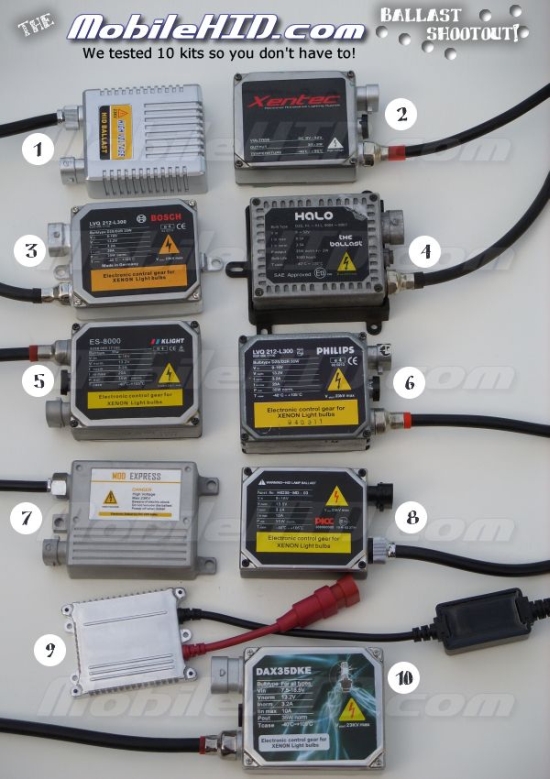
Quick summary of the 10 ballasts list:
1) No name generic ballast. Didn't come with a harness and wasn't rubber injected so it didn't meet the waterproof/shockproof standard. Additionally, this ballast had no mounting brackets so it was impossible to secure it once installed.
Verdict: Just another piece of garbage on eBay.
2) Xentec. Didn't come with a harness so they failed the requirements. These can be found on eBay for $40-$60 shipped.
Verdict: Not worth it unless you plan on getting 2-3 sets. You'll need them unless your eBay vendor lives up to the warranty they promise.
3) Bosch. A knock off ballast trying to be sold under a reputable name. No harness but offered a soft start on the bulbs. Not rubber injected either.
Update on 3/8/2010: This ballast is now also being marketed as a Philips ballast. Please be aware and do not fall for the false advertising. Philps no longer produces a ballast for kit usage.
4) Halo. No harness included and this halo ballast died within 6 months of install and has now gone to ballast heaven. These can be found on eBay for $150-160.
Verdict: Not worth it without a harness. The one we had died after 6 months of operation and the eBay vendor refused to honor the warranty.
5) Klight. No harness with hollow internals. Reliably flickered once approximately 50 seconds after each startup. Very odd.
Verdict: Not worth it at $160 on eBay. There is no harness why would you buy something that will reliably blink once every time you turned them on?
6) Philips. Works great, soft start,
not waterproof but comes with a plastic protective case.
Came with a harness but this was a $400 kit (5 years ago) and Philips no longer makes ballasts for kit usage.
Verdict: These set the benchmark back in the day for the HID kit world. They are no longer made unfortunately.

7) Mod Express. No harness and the
back of the ballast was a thin aluminum plate (like a soda can) that provided
no protection for the internals. Upon removal of the thin
backing, a sandy grit was found on inside with all components
sloppily covered with rubber to protect the electrical components.
Verdict: If you purchase these, you might as well run your money through the shredder.


8) PICC. No harness and the case developed
rust spots after the 20 minute dunk in the water. Shoddy
quality.
Verdict: You can probably buy these on eBay but seriously it's just another eBay kit that will rust and sells for $60-70. No harness, no bueno, mein freund. (Was that last sentence awesome or what? Seriously, English, Spanish, and finishing it off with German!)


9) Generic slim style ballast. No harness included and was noticeably dimmer than every other ballast. Doesn't have any internal power regulation and 3 our of 4 test ballasts suddenly turned off by themselves during a 1 hour test. They fired back up when switched off and then back on. Failure rate was ridiculously high.
Verdict: Don't buy these
10) Comes with a harness, case is rust proof, shock resistant, and waterproof. A video of this ballast powering an H4 bulb despite being repeatedly beaten with a hammer can be found on the homepage. They can be purchased at HongKongHID.com.
Let's begin with the stress test requirements:
1) A wire harness must provide power directly from the battery to
the ballasts. For safety reasons, if you are introducing a 12v load to your vehicle's electrical system, you should never connect directly to an existing plug for power. The IDEAL wiring schematic enables the headlight plug to trigger a relay and the
relay then connects power from the battery to the ballasts.
Lighting kits that passed this test: Philips, Ballast #10
2) The ballasts have to be rubber injected. This ensure the
ballasts can withstand the elements. Rubber injected
ballasts ensure water will not harm the internals, but it also ensures
electronic parts inside will not get jostled around during harsh driving
conditions.
Lighting kits that passed this test: Mod Express, Xentec, Ballast #8, #9, #10.
3) Good quality wiring. Some kits that have really thin gauge
wires and cheap looming that you would be ashamed to put on a go-kart.
Don't waste your time with an inferior kit that has shoddy wires or
even no wire harness at all.
Lighting kits that passed this test: Philips, Ballast #10
4) One-piece ballasts. This means, no external ignitors. All other
kits had integrated ignitors in their ballasts.
Lighting kits that passed this test: All ballasts except for ballast #9 and the McCulloch ballast
5) Universal wire connections. This means no proprietary wiring
so your ballasts will connect with the most common wire harness. All the ballasts that we tested use the Hella Gen 3 style connection that looks like an electrical plug inside of an somewhat oval plug. In general, this is good because if you ever need to replace one part, you don't need to replace the whole kit or splice wires.
Lighting kits that passed this test: All ballasts except for the McCulloch ballast
Consumer note: For safety reasons, if you are introducing a 12v load to your vehicle's electrical system, you should never connect directly to an existing plug for power. Much like the car audio industry, any time an aftermarket amplifier is added, a direct line to the battery is added.
|